For more Museum
Boats, see Dredger & Sabrina 5, Tug
Progress and Progress at Work
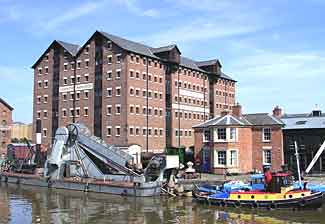 This page gives some basic information about each of the
historic craft on view at the Gloucester Waterways Museum, and links
lead to other pages giving more details and pictures. This page gives some basic information about each of the
historic craft on view at the Gloucester Waterways Museum, and links
lead to other pages giving more details and pictures.
Steam Dredger SND No 4
SND
No 4 was built in Holland in 1925 and was used on the Gloucester
& Sharpness Canal and docks until 1981. When dredging, the bucket
ladder was lowered to the required depth, and the buckets tipped
the mud into a hopper barge moored alongside. It is maintained as
a working exhibit by the Friends of the Museum. (More)
Tug Severn Progress
Severn
Progress was built in 1931 by Charles Hill & Sons of Bristol
for the Severn & Canal Carrying Company based in Gloucester.
She was mainly used for towing barges and canal boats on the River
Severn between Gloucester, Worcester and Stourport until this commercial
traffic died out in the late 1960s. After several years helping
with maintenance work on the Kennet & Avon Canal, Progress
is now looked after by the Friends of the Museum, who use her for
tug handling courses and occasional towing jobs. (More) Top
Barge Sabrina 5
Sabrina
5 was one of six unpowered barges built in 1944 by Charles Hill
& Sons of Bristol for the Ministry of War Transport. They were
mainly used for carrying 130 to 150 tons of imports from Avonmouth
to Worcester or Stourport via the Gloucester & Sharpness Canal
and the River Severn. The barge fleet was formally disbanded in
1969, and after several years of idleness, Sabrina 5 was
restored to join the Museum's collection in 1988. In 2017, she was given a new role, as an
access way was installed and
her hold was converted to a meeting and education centre. (More)
Top
Narrow Boat Northwich
Northwich
was built at Saltley, Birmingham, in 1898 for the well-known carriers
Fellows Morton & Clayton. Originally pulled by a horse and later
towed by a motor boat, Northwich was mainly used for carrying
a wide range of general cargoes on the canals between London and
Birmingham. After the nationalised carrying fleet was disbanded
in 1964, Northwich spent many years at Stoke Bruerne, first
in the weighing machine and then as a floating exhibit, and eventually
came to Gloucester in time for the opening of the Museum in 1988.
Top
|